

The Snowglobe Effect: How to Create a Reality That Serves Your Dreams
Discover the difference between fantasies that fuel growth and those that keep you stuck. A guide to using 'Productive Fantasy' as a tool for overcoming doubt.

Hello there! In this article, I aim to show when believing in a fantasy for a while can lift you up and when it can distract you from reality. Meaning, reality, self-deception, resilience, and ambition: these are the themes I’ll also be tackling. First, I’ll quickly mention how I connected Don Quixote with this subject, and then I'll talk about when believing in a fantasy is helpful and when it is burdensome.
Before moving on, I want to quickly mention what motivated me to write this. Have you ever found yourself thinking, “Oooh, no way, that’s so crazy, I can’t do it”? The answer is, it’s highly likely you can. I have a weird stubbornness and decisiveness. If I decide on something, I don’t stop until it happens — not with the motivation of bursting into flames and burning out my inner engines, but with a different kind of drive. I just go to the edges of my existence and test my limits to see how far I can go to achieve that one thing. I also want to emphasize that I believe in fate, so the moment I know I’ve done my part, I don’t push it; I let it be. Apparently, this is not a trait everyone has. I was very surprised when I first encountered this difference, and I am still surprised whenever I see other examples. So I keep finding myself saying to people with my inner voice, “You can do it!” And so, I decided to write this.
The Relevance of Don Quixote’s Madness (Or Non-Madness) to This Article
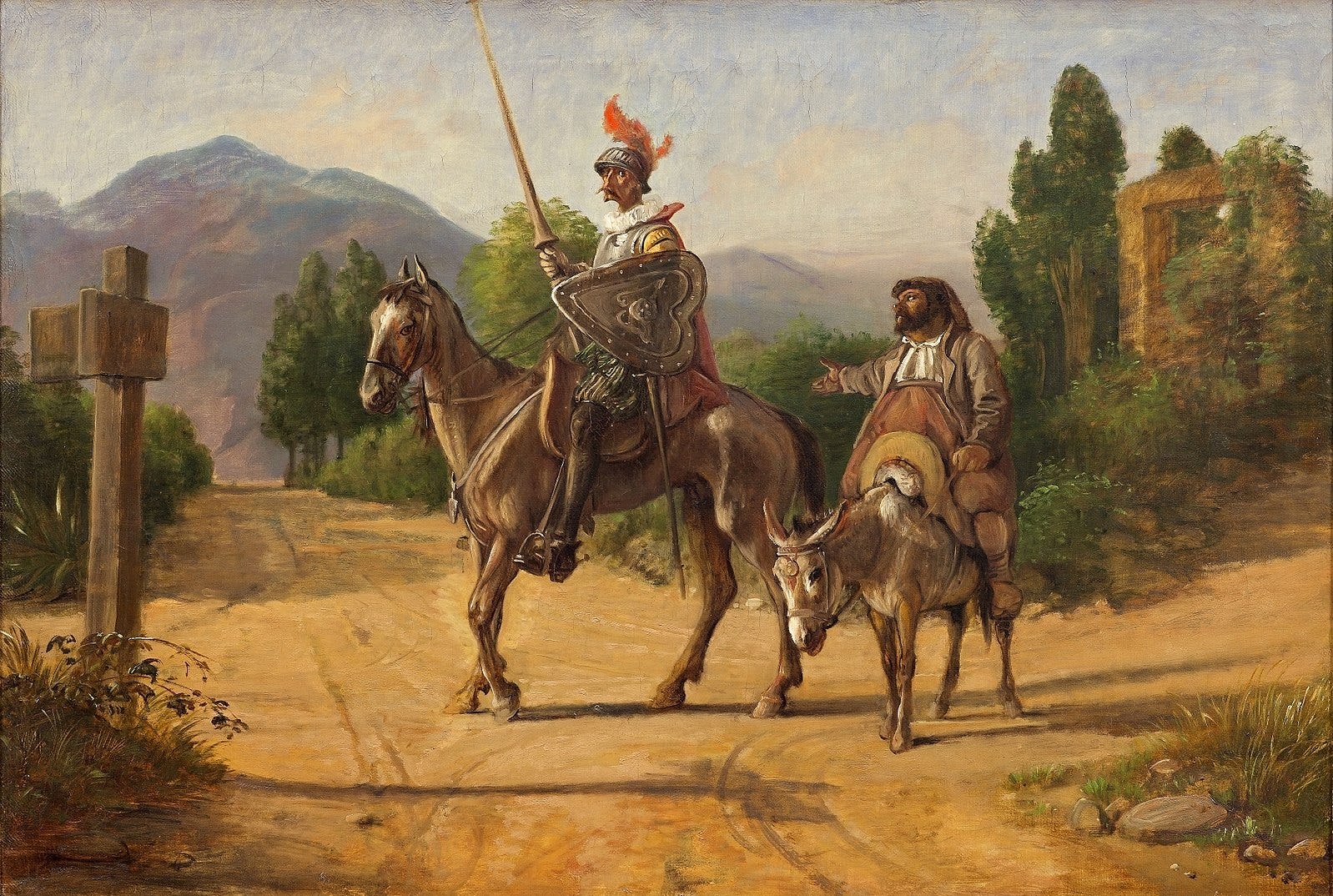
I’ve recently been reading Don Quixote, and his character reflects many things, but the first thing I noticed was that he created his own reality and believed in it religiously. The reality around him and his idea of himself don’t match, or at least that's how it looks at first glance. It’s long been debated whether he’s mad or not. I haven’t finished the book yet, but the way I see his character, I don't think he is mad. I think he created the only meaningful way of living for himself rather than facing reality.
Deep down, I think he knows. He knows he’s not a knight-errant; he knows he doesn't have the love of his life and that he made Dulcinea up. But still, wouldn’t it be rather boring and pointless to remain as he is, in his later years, with no significant legacy? He represents the desperate soul of humankind in the pursuit of meaning, the pursuit of something to leave behind proudly, of having something worth talking about. He chose to lose himself in those novels in the first place, anyway. He is aware. He is smart enough to create perfect sidewalks when the main roads don’t go the way he wants them to. He places puzzle pieces around the real world and steps on those as he walks on this journey. He is in denial, but he prefers not to admit it.
When our reality is too much to comprehend, requires too much effort to change, or is too brutal to accept, we simply start an engine within us called the “Survival Instinct.” Because we can’t change our harsh realities, we twist them here and there in our minds so that we can continue living without compromising our core beliefs. We may believe, “If you do good, good will return to you,” and similar statements. And facing our reality might require facing the things we believe may not be true. Accepting that “Life is not fair” or “Doing good does not always bring good back to you” can be hard.
Don Quixote chose to act mad because that’s how he coped with an unwanted reality he couldn’t change. He believes in a fantasy. But is believing in a fantasy always a bad thing?
When a Dose of Fantasy Is a Tool for Achieving "Crazy" Things
I am usually brutally honest with myself, but sometimes I may not be too realistic considering the circumstances: I had to be a bit “crazy” to imagine some of the things I've pursued in the past. If I had told anyone else what I was aiming for, that fragile snowglobe I could barely hold in my hands would have been shattered on the floor in a second. So, I kept it to myself for a while. I was aware I was believing in a fantasy, but it was a necessary tool to overcome the circumstances.
We, in our small bubbles, tend to understand life based on who we are surrounded by and the things we see around us. I dared to see beyond that sometimes. I thought I could become this version of me or that version, and if I had told people, they would have thought I was mad. They comprehend the world with the words they’ve read, the scenery they have seen, the thoughts they’ve exchanged, and the "desires" created among themselves that they deem worth wanting. To have the vision I have right now, I had to believe in some fantasies in some of my previous stages; it was necessary.
I was intentionally shooting for the stars and validating myself with my own logic: If I were to become who I want to become, this is the only time I could do it, while I am healthy and young and able to take risks. The weirdest conflict of my mindset is that not taking the right risk at the right time is the biggest risk of all. Sometimes we are swayed by the fears reflected onto us by others, little knowing that each individual and circumstance is unique. We should decide our life's strategy based on our own skills, abilities, strengths, and weaknesses—not on some generic “next big thing” idea that people think is one-size-fits-all. And if we don’t have like-minded people around us when pursuing a big dream, then believing in a dose of fantasy can help.
How to Start Your Passion Project: A Motivational Roadmap to Prioritise, Plan, and Keep Going

As someone who has tried many productivity, time-management, and goal-planning techniques. This article summarizes what I’ve learned about getting started and what has actually worked for me. Please check it out if you struggle with starting.
When a Fantasy Becomes a Cage Built by Survival Instinct


I am always surprised to see people who believe they couldn’t be something they want to be because of this or that. The more I observe, the more I realize they believe in fantasies too. But instead of doing it to shoot for the stars, they do it backwards. They tend to see themselves as being stabbed by the stars. Seeing people who become a more aligned version of what they were meant to be hurts them because they couldn’t start the journey of discovering their own true selves. And rather than examining, dissecting, and analyzing their own atoms, they try to find the “why” externally. Because they failed in primary school. Because someone once mocked them. Because they have a trauma they couldn’t overcome.
Don't get me wrong, I’m not underestimating the effects of any of these things on one’s life, but my take is that many people have these struggles. My reaction is to ask a question: “How did the people who succeeded do it, even with trauma in their past? Could their method or mindset be helpful for me, too?” I simply do not believe some people are inherently better or luckier and that others aren’t. If you want to become something, you need to get up and do the hard work. Again, cliché but true: There is no one else on your way to stop you but yourself. Honestly, I saw a video on YouTube about the victims of abusive parents. They were children who had been imprisoned for years by their family and hadn't spoken to anyone else. As a result, they didn’t know many basic words, yet they dared to escape and pursue a normal life and their dreams. Or the painters without hands who paint with their mouths and feet. These examples should show us that we shouldn’t complain, because if these things are possible, many things are possible.
This is not to say, “There are people dying, and your issue is unimportant.” Your issues and struggles are very important, but you can handle them, fix them, and move on to the next stage of your life. That’s what I’m saying.
How Do We Know Whether We Are Believing a Fantasy to Escape or to Achieve?
The snowglobe you create is there to hold a fantasy of achieving something beautiful you think is not possible at the moment, not for you to fill with “I would have, could have”s. To explain this a bit more, let’s compare two examples below. For both of these examples, a person's social circle might think the goal is impossible:
“I want to be a superstar.”
“I want to write a book in another language.”
Being a superstar happens to, I don’t know, 30-40 people in the same decade? Do you want to invest all your energy in that? Is it worth it? Do you want the perks of being popular, or do you honestly have a bursting passion for making those songs? On the other hand, let’s say you are Korean and a huge fan of Shakespeare and want to write a book in English. As a fluent English speaker, although I have been speaking this language for almost two decades, many things will never be fully embedded in my brain because my primary thinking will always be in Turkish, and so the way I create sentences is different. We don’t have “the.” We don’t have he/she/it; we have “o,” which is the equivalent of all of them. Since Turkish is my mother tongue and my “norm” for a language, English feels like a fragmented language because I need to use more words to convey the same meaning than are needed in Turkish, where we keep modifying the words. When reading a novel by an English-speaking author, although I can understand what they say, I don't always feel it, so I often read in Turkish.
Back to the point. Korean is a language grammatically similar to Turkish, and when a Korean speaker decides to write an English book, it may not be encouraged by their social environment. But the thing is, it might be worth it, and it is not impossible. If that person really has a passion for it, why not? That could be their snowglobe. Whereas becoming a superstar is likely something one likes to imagine for their potential, rather than something one truly wants to pursue, and that makes it a deceiving fantasy.
I recently watched Christy Anne Jones’s video about her journey of publishing her debut novel, a book she had been working on for five years. It’s a good and solid example of how helpful it is to believe in a "fantasy" for a while—until, as you see by the end of the video, it becomes real. I also really like the way she includes everything that happened in her personal life during the publishing process—the querying, finding an agent, and submitting the draft to editors. It's a great way of storytelling through the video medium.
Key to Resilience: Why Moving On and Knowing How to Lose are Skills

I think being resilient is an underestimated trait, and if one has it, they’re way ahead of others in the game. Check out this article if resilience sounds like something you’d like to work on.
All in All
So, what I’m trying to say is this: Some snowglobes distract you from your true potential. They create an “I could be this! I am that talented!” safety net that, for your survival mechanism, ultimately leads you nowhere but to a state of complaining about how unfair things are.
Other snowglobes, however, can lead you to a happier, more content version of yourself and push you to become, become, become. I am not saying you can’t be a superstar, by the way; just do your due diligence and analyze all aspects. Little do we analyze the burden of abundance. As the honorable Justin Bieber once said:
Everybody knows my name now
But somethin' 'bout it still feels strange
Like lookin' in a mirror, tryna steady yourself
And seein' somebody else
Everybody knows my past now
Like my house was always made of glass
And maybe that's the price you pay
For the money and fame at an early age
What if you had it all
But nobody to call?
Maybe then you'd know me
'Cause I've had everything
But no one's listening
And that's just lonely
Some stars aren’t worth shooting for. Anything above a certain amount of money, and fame requires so much time, energy, and emotion from your life. The balance is the beauty. The “somewhere in between” is the beauty. Don’t hide behind the bars of fake fantasies. Chase the truth you want. Be brutally honest with yourself, even when you know you are believing in some sort of fantasy. Check what is worth being your snowglobe. Keep it tidy and polished, and for your own eyes. For a while, it will stay as a fantasy. Until it becomes real. Until you make it real, make it happen, and show the others solidly, in flesh and bones.